Thursday, December 22, 2011
Thursday, December 15, 2011
Random projects
Handspun from Little Wool Company (Anna Gratton) corriedale sliver. One sliver multi shades and the other plain bordeaux.
Greek key, my first attempt at double weave pick up, which I really enjoyed. But shock horror, can you see where the dye ran into the white. Is there any way to remove the run of dye? The rust thread is a guide to rap it straight around a canvas block. I will have another go at this as I like the clean lines.
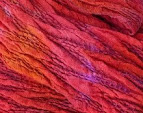
The blotchy variegated fabric using space dyed warps, one dark and the other an echo of it. Woven echo weave, 28 epi, 560 threads, wove almost 5 metres giving me approximately 4.5 metres of cloth. I'll have to do some fancy cutting out to obscure the band that stands out as being different (shame it wasn't on the outside edge). The cotton tags are my half metre marks as I weave which I find less muddly than using string or a tape measure which I always seem to get tangled in and pull on. I cut the tags before I start weaving and as they're used I know how many metres are woven and how many to go. The tags also give me an idea of take up and shrinkage after fulling, in this case shrinkage was 4 cm per 50 cm, and a pause to stretch my back.
Greek key, my first attempt at double weave pick up, which I really enjoyed. But shock horror, can you see where the dye ran into the white. Is there any way to remove the run of dye? The rust thread is a guide to rap it straight around a canvas block. I will have another go at this as I like the clean lines.
The blotchy variegated fabric using space dyed warps, one dark and the other an echo of it. Woven echo weave, 28 epi, 560 threads, wove almost 5 metres giving me approximately 4.5 metres of cloth. I'll have to do some fancy cutting out to obscure the band that stands out as being different (shame it wasn't on the outside edge). The cotton tags are my half metre marks as I weave which I find less muddly than using string or a tape measure which I always seem to get tangled in and pull on. I cut the tags before I start weaving and as they're used I know how many metres are woven and how many to go. The tags also give me an idea of take up and shrinkage after fulling, in this case shrinkage was 4 cm per 50 cm, and a pause to stretch my back.
Labels:
corriedale,
double weave pick up,
echo weave,
handspinning
Sunday, December 11, 2011
Eumachia
Eumachia was priestess and one of the most prominent citizens of the city of Pompeii. She was patroness of the guild of fullers (cleaners, dyers, and clothing makers), one of the most influential trade-guilds of the city because of the importance of the wool industry in Pompeii's economy. Although her ancestry was humble, the fortune she inherited from her father, a brick manufacturer, enabled her to marry into one of Pompeii's older families. She provided the fullers with a large and beautiful building on one side of the Forum which was probably used as the guild's headquarters.
![]() |
| Eumachia Priestess of Fullers |
![]() |
| Entrance to Fullery |
The elegant doorway is faced with fine marble which is carved with acanthus leaves.
This small room's entrance is to the right of the main marble arch. Gentlemen could discretely pop in while passing and pee in a buried urn providing a source of urea for the cleaning process.
Fulling consisted of cleaning raw wool or cloth in vats of urine, soda and fuller's earth. The workers trod the cloth in this mixture to clean it. It was then rinsed in a series of other vats and hung to dry. The cloth was combed, brushed and trimmed and white cloth was bleached by laying it on a cage over burning sulphur and brimstone. The final process was the pressing of the cloth which was done in a press at the entrance of the fullonica of Stephanus, the most famous of four large laundries in Pompeii.
Wednesday, December 7, 2011
Weaving in Crete and Rhodes
When in Chania two years ago I found this shop, Roka Carpets, full of woven goodies and right at the back was a LOOM but the shop was never open. I would stand at the window and peer in, like "the little match girl". I eventually learnt that the weaver, Mihalis Manousakis, had had to get a job that paid "real" money to support his young family.
Roll forward two years and the doors were open and Mihalis's daughter was there looking after the shop on behalf of her stepmother, Anja, who was now the weaver. Mihalis is working as a scaffolder.
![]() |
| Roka Carpets |
![]() |
| Roka Carpets |
Two strips of cloth being woven simultaneously and paper to separate the projects.
![]() |
| Roka Carpets |
![]() |
| Roka Carpets |
I love the tangle of threads on the centre support of the swift and the tree trunk its resting in.
The Roka patterns are from Minoan time.
One of my questions about Greek weaving has been, why have the traditional looms never been developed to make the weaving easier and why still just using two shafts. On occasion I saw a four shaft loom but shafts 1&2 and 3&4 were tied together to act as a two shaft loom. Maybe the answer lies in this article in the Crete gazette where they say
"There was a time on Crete when every house had a loom. Weaving was as essential as cooking. "
Weaving wasn't a fun thing to do or an art form but part of the daily chores.
Before we left home I had read that Kritsa was the centre of weaving on Crete and as this was one of our destinations to meet up with Pete's cousin I was quite excited but, alas, it seems the last weaver had recently passed away and, although several ladies had looms in their houses and were interested in learning weaving there was no one to teach them.
![]() |
| Kritsa |
![]() |
| Kritsa - having a go. My feet weren't far enough up the straps and I didn't get a very good shed. |
![]() |
| Rhodos museum |
Wednesday, November 23, 2011
Benaki Museum
First, the San Francisco air port had a display of work by Joseph Frank from Sweden. I wrote down the date of 1928 for this selection. Its behind glass, hence the reflection.
We had a morning in Athens before our flight to Hania, Crete so chose to see the Benaki Museum. This holds a collection of work from Neolithic times onwards and was donated by Antonis Berakis (1873-1954) to the Greek state in 1926. Lots a examples of fibre and costumery.
I took photos of the descriptions so I'm typing them out for my benefit.
Fragment of a linen tunic band, decorated with a grid pattern of lozenges and medallions with symmetrical motifs. From Egypt 8-9thC.
Linen and woolen screen curtain in the loop-weave technique with the representation of a praying couple. From Antinoe, Egypt 5-6thC.
Wooden winding frame for preparing hanks of yarn. 19thC.
Spindle whorls of bone. The painted or carved decorative motifs must have created a particularly pleasing aesthetic effect during the rotation of the whorls.
Wooden spinning wheel. From the islands. 19C. For the life of me I can't figure how this works as a spinning wheel but I love the skein winder in the background.
Wood carved loom from Crete early 19th C. I have the feeling this loom isn't set up properly as the cords to the two shafts seem to be attached to the front beam. Lovely carving and solid loom. In the background (rightish of the loom) is a bridal tent.
Tapestry for costume decoration, woven in wool and linen. It is distinguished for the high quality of the workmanship and the grace of the depicted quail. 5th C.
Part of a woollen bedspread woven with a design of a couple on the tree of life. From Kritsa, Crete. 18-19th C.
We had a morning in Athens before our flight to Hania, Crete so chose to see the Benaki Museum. This holds a collection of work from Neolithic times onwards and was donated by Antonis Berakis (1873-1954) to the Greek state in 1926. Lots a examples of fibre and costumery.
I took photos of the descriptions so I'm typing them out for my benefit.
Fragment of a linen tunic band, decorated with a grid pattern of lozenges and medallions with symmetrical motifs. From Egypt 8-9thC.
Wood carved loom from Crete early 19th C. I have the feeling this loom isn't set up properly as the cords to the two shafts seem to be attached to the front beam. Lovely carving and solid loom. In the background (rightish of the loom) is a bridal tent.
Tapestry for costume decoration, woven in wool and linen. It is distinguished for the high quality of the workmanship and the grace of the depicted quail. 5th C.
Part of a woollen bedspread woven with a design of a couple on the tree of life. From Kritsa, Crete. 18-19th C.
Ladies in costume. Left: Bridal costume from Kawakli, NE Thrace. Middle: female costume Eastern Thrace. Right: Bridal costume of Kapoutzida, central Macedona.
Tuesday, November 15, 2011
Finally weaving
The good news is that all the oil that can be removed is off the Rena, container ship that ran aground off Tauranga Harbour, and any left will be "mopped up manually". I do hope the mopping happens on board and not on the beaches. Container removal starts today but with over 1300 containers and only 6 being removed per day it will take a while. The spine of the Rena is broken so the fear is a storm could turn the whole situation to custard.
I finally got to sit at my loom last week and produced 5 metres of fabric which I'm calling wisteria. This was the culmination of all the sampling I did during the winter of interleaved and echo warps. I really can't say it is echo as I broke all the rules (as usual). The warp had been wound with one thread wool and the second thread has some fibre which didn't take the dye (acrylic probably as I gave it the bleach test) so it was an echo of the main thread. Unfortunately the threads had stuck together slightly so I had to stand and separate all 520 6 metre long threads before winding them on. Wool is questionable to use for echo weave anyway but because it was now slightly fluffy it couldn't be sett as close as it should have been. I did cut off a sample and wash it vigorously before preceding. Putting all the elements together- the painted warp, echo weave threading, the warp sett I'm very pleased with the result though it is yet to be fulled.
In the evenings I've been knitting a jumper for Jack who, we've found out, is allergic to wool and acrylic. Not what you want to hear when his GranD has a house full of wool. Our last two days of holiday were a stop over in San Francisco and as luck would have it Arftibers was just around the corner from our hotel, not even a block away. I had arrived in fibre heaven, there were bins and bins of thread and sample squares knitted of each variety and complete garments on display. I shouted Jack (note how I shift the blame) some recycled denim thread. Its rather soft to work with compared to other denim threads I've used. Also some silk for myself.
And finally I just heard that Peter Gordon, London based master chef, bought my kereru blanket from Pauanesia (go to gallery) as a gift for himself. I'm one proud cookie!
I finally got to sit at my loom last week and produced 5 metres of fabric which I'm calling wisteria. This was the culmination of all the sampling I did during the winter of interleaved and echo warps. I really can't say it is echo as I broke all the rules (as usual). The warp had been wound with one thread wool and the second thread has some fibre which didn't take the dye (acrylic probably as I gave it the bleach test) so it was an echo of the main thread. Unfortunately the threads had stuck together slightly so I had to stand and separate all 520 6 metre long threads before winding them on. Wool is questionable to use for echo weave anyway but because it was now slightly fluffy it couldn't be sett as close as it should have been. I did cut off a sample and wash it vigorously before preceding. Putting all the elements together- the painted warp, echo weave threading, the warp sett I'm very pleased with the result though it is yet to be fulled.
In the evenings I've been knitting a jumper for Jack who, we've found out, is allergic to wool and acrylic. Not what you want to hear when his GranD has a house full of wool. Our last two days of holiday were a stop over in San Francisco and as luck would have it Arftibers was just around the corner from our hotel, not even a block away. I had arrived in fibre heaven, there were bins and bins of thread and sample squares knitted of each variety and complete garments on display. I shouted Jack (note how I shift the blame) some recycled denim thread. Its rather soft to work with compared to other denim threads I've used. Also some silk for myself.
And finally I just heard that Peter Gordon, London based master chef, bought my kereru blanket from Pauanesia (go to gallery) as a gift for himself. I'm one proud cookie!
Subscribe to:
Posts (Atom)