Saturday, October 24, 2015

SKI-ing

Well hello, yes we've been SKI-ing, that is Spending the Kids Inheritance.  We've been on an awesome adventure to Italy with most of our time spent in Tuscany.  Some years ago Pete and I had been to the library, I went out to the car and started looking through Nicki Epsteins book about yarn shops in Tuscany.  When Pete came out I showed him what I was looking through and he fosocked in his bag and pulled out Lonely Planet Guide to Tuscany and so a dream started.

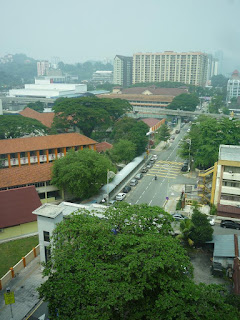
We flew from Auckland to Kuala Lumpar to break the journey for a night.  This is a view from our hotel window to show the smoke from Indonesian fires.  We couldn't see anything past the multistory building and the collar of Peter's shirt - black.
From Rome airport we trained straight to Orvieto, a medieval hilltop town we had stayed in before and chilled out there for a few days.  Took a bus trip to Civita, another medieval castle town on top of a hill but the hill is slowly falling away taking the buildings with it.  There is no vehicle access except scooters and 4 wheel bikes to takes in supplies
 but around every corner is beautiful picture.
 You can see below how one building is occupied and looked after and the one on the left is unoccupied, plants growing out of the walls and in danger of collapse.
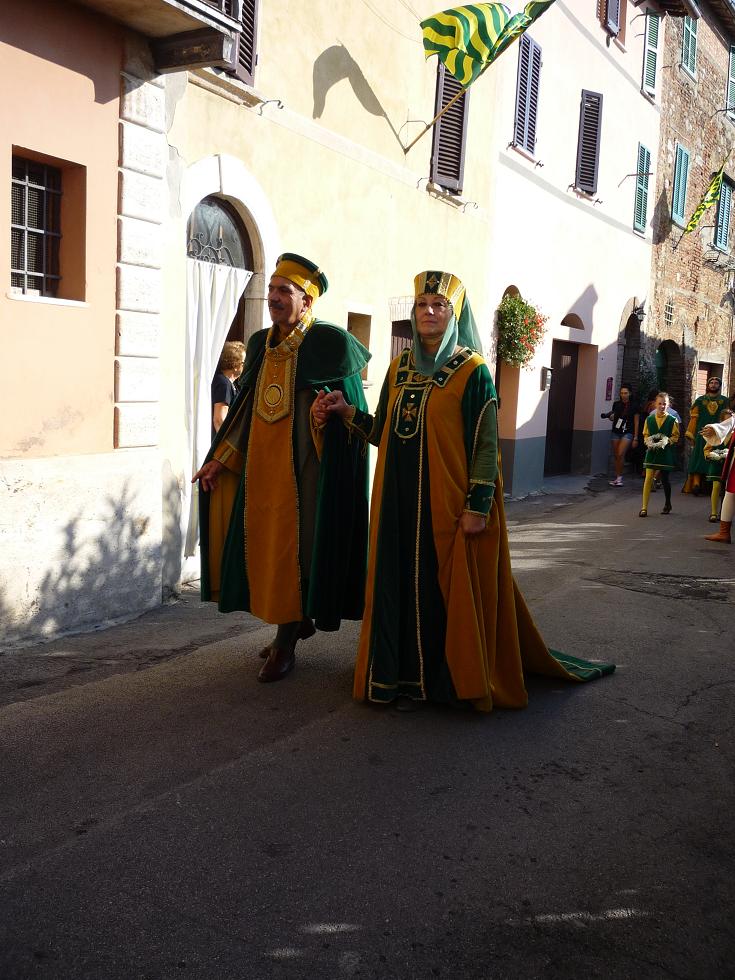
 Next stop was Montepulciano, yes, another medival town on a hill and we were there for the Wine Barrel Rolling Festival.  My pre-trip exercise program of walking up and down Bowentown Hill stood me in good stead here as there were a lot of steep streets.  The Festival included a parade of each contrada or family dressed in ancient costume walking the 1.8 kilometer track mostly uphill in about 30 degree C heat.  This couple have 3 or 4 layers of velvet on.
 No pictures of the barrel rolling, they were too fast for my little camera.  An 80 Kilo barrel, one guy rolling it from the back, second guy at the side also keeping it moving but also steering it, 1.8 k up hill around corners, some 270 degrees and so fastand so fit.  Our landlady was tickled pink that the last team came in after the ambulance but really just to finish was amazing.  And then the party began, pit roast, wine and singing.

We took a short bus trip to Prezia and I was delighted to meet Paola and Mattia in their weaving studio and they were working with NZ merino yarn.  The greasy fleece is sent to Italy where its spun and they were enjoying weaving with it.  I can't buy fine merino yarn in NZ!

Our next stop was Padua, mainly as a jump off point for Venice but also an interesting city in its own right.
Venice is unique, of course. 
The canals and buildings - so picturesque.


Grand Canal
Inside courtyard of Doge's Palace
The Bridge of Sighs.  The last view prisoners got of Venice
as they were led from the courts in the Palace to the prison.
And a last canal view before we move on to Florence.
Until next time ...

Friday, August 21, 2015

Kea blankets

The New Zealand kea is an endemic parrot found in the South Island's alpine environments.
Kea are a protected species. They are rated as one of the most intelligent birds in the world. 
To survive in the harsh alpine environment kea have become inquisitive and nomadic social birds - characteristics which help kea to find and utilise new food sources.
Their inquisitive natures often cause kea to congregate around novel objects and their strong beaks have enormous manipulative power.
Being lazy (or rushed for time) I've uploaded this information from Department of Conservation web site.
Kea blankets, soon to be available from Pauanesia, Auckland.
A while back I thought to use up some of the stash in an autumn blanket.  A friend said Nice blanket but I can tell you, you can't see a gap in the stash!
There were 28 chains of different yarns and colours.  I new I had to mix them up to alleviate the different shrinkage rates.  I didn't do too bad except the two chains I put together right in the centre and neither of them shrank as much as the rest.  No one will see when snuggled up to keep warm but I can't sell this.
Do the colours remind you of the Kea?
Exciting news.  This blog is going on holiday so after many adventures in Tuscany I'll tell you all about them in October.  
Now to pack the suitcase.

Sunday, August 16, 2015

Takahe scarves

The flightless takahē (Porphyrio [Notornis] hochstetteri) is a unique bird, a conservation icon and a survivor. The takahē has clung to existence despite the pressures of hunting, habitat destruction and introduced predators. 
Mitre 10 Takahe Rescue logo.The takahē was once thought to be extinct, but was rediscovered in 1948. Even today, despite years of conservation effort, the takahē remains critically endangered.
DOC's Takahē Recovery Programme in partnership with Mitre10 Takahē Rescue is committed to ensuring the survival, growth and security of takahē populations throughout New Zealand.
 From an era when large flightless birds were spread throughout New Zealand, the takahē has clung to existence despite the pressures of hunting, habitat destruction and introduced predators. 
The takahē was once thought to be extinct, but in the 1948 it hit world headlines when an Invercargill doctor, Geoffrey Orbell, rediscovered the bird high in the tussock grasslands of the remote Murchison Mountains, Fiordland.
Even today, despite years of conservation effort, the takahē remains critically endangered.

Are they just fat pūkeko?

No! A takahē looks similar to the common pūkeko, probably because they share an ancestor, so they are very distantly related.
However, where the pūkeko is skinny and blue with a black back, the takahē is much larger and more colourful. It has a large, strong red beak and stout red legs. Its gorgeous feathers range from an iridescent dark blue head, neck and breast to peacock blue shoulders and turquoise and olive green wings and back.  
Adult takahē are about the size of a large hen, 50 cm high and can weigh over 3 kg.
Takahē are flightless. They have wings, but they only use them to display during courtship or as a show of aggression.
Takahē have lived over 20 years in captivity but in the wild few birds reach this age.
(Information from http://www.doc.govt.nz/nature/native-animals/birds/birds-a-z/takahe/)


And that is the last in this Plumage series celebrating Pauanesia's 20th birthday.
I hope you've enjoyed learning a little about some of New Zealand's colourful native birds 
and seen where I get the inspiration for a lot of my weavings.

Friday, August 14, 2015

Tui scarves

 Tui, endemic to New Zealand, are boisterous, medium sized, common and widespread birds of forest and suburbia.  They look black from a distance but in good light tui have a blue, green and bronze irridescent sheen and distinctive white throat tufts (poi).

Adults have a notch on the 8th primary feather and this feather quivers from the narrow part creating the whirring sound common in flight.  They have a noisy unusual call but can also replicate human speech.

Tui are notoriously aggressive and will defend a flowering or fruiting tree from all comers.  They vigorously chase other birds away from their feeding territory.
photo from blog.tepapa.govt.nz
Photographer Tony Whitehead

Tuesday, August 11, 2015

Kotare Scarves


Our neighbours, the Australians might not be putting on a decent show at cricket for some weaver's liking but they beat the All Blacks at Rugby last weekend!!  But we won the netball so all's fair in TransTasman rivalry.

Sorry to be repeating information here but Kotare is one of my favourite colour way resources.

New Zealand's sacred kingfisher or kōtare is a cousin of the kookaburra in Australia. It’s ancestors flew here from Australia around 10,000 years ago.  Kingfishers are found widely in New Zealand in a wide range of habitats, the key ingredient being an elevated position for observation.   The Kotare is a distinctive bird with a green-blue back, buff to yellow undersides and a large black bill.


Sunday, August 9, 2015

Tara-iti or New Zealand Fairy Tern

With a  population of around 45 individuals that includes approximately 12 breeding pairs, the New Zealand fairy tern is probably New Zealand's most endangered indigenous breeding bird.
It is ranked as an endangered species, and carries a "Category A" priority for conservation action.  A Department of Conservation Recovery Plan is currently in action.
The New Zealand fairy tern/tara-iti is the smallest tern breeding in New Zealand with adults measuring around 250mm in length and weighing a mere 70 gms.
During the breeding season NZ fairy terns are easily picked out be their black caps (coming around in front of the eye), soft grey feathers, white chest, yellow bill and orange legs.
In non-breeding plumage the crown fades into a mottled black and white, the bill fades to a dull orange-brown and the legs fade to a dull orange colour.
These delicate sea birds nest over the summer period on the rugged West Coast beaches and at two sites on the east coast of Northland, Mangawhai and Papakanui Spit. 
Information from Department of Conservation.


The scarves representing Kokako, Kereru and Tara-iti were woven in a false damask (2 blocks of 4 shafts each) with basket weave selvedges and a double weave hem using 16 shafts altogether.  All the merino was hand dyed.

Saturday, August 8, 2015

Kereru scarves

Kereru or New Zealand Pigeon or Wood Pigeon
grows to about 50cm and reaches a weight of 650 gms.
The head, throat and wings are generally a shiny green/purple colour with a bronze tinge to the feather tips.  The breast is white.
 Kereru primarily eat fruit from native trees especially karaka and taraire and they are the only bird big enough to disperse the seeds from bigger fruit throughout the forest.  They also browse on leaves and nuts.
Introduced mammals such as possum and rats have significantly reduced the amount of fruit available and these migrants also eat the eggs and nestlings.
The kereru has been under total protection since 1921.
 Warp, looking down on back beam

Three different grey wefts, dark, medium, and light on these reversible scarves, part of the Plumage series for Pauanesia
Woven in false damask, 2 blocks of 4 shafts each, all hand dyed.