Wednesday, July 4, 2012

Weaving catch up

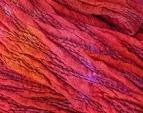
 Straight off the loom, Kereru, New Zealand pigeon.
 Sewing a tunic top.
 Ooops, the fabric wasn't wide enough for the bodice.  But needle and thread (and Daryl Lancaster) to the rescue.
 I didn't get the hang of the join to start with (see bottom right of join) but when its done properly its hardly visible, in fact I had to use the embroidery magnifying glass to do the job.  And then I realised that most of it will be covered by an outside facing and seam.
And finally, a close up of the fulled diversified plain weave.  I studied the pictures in the latest Handwoven magazine and I'm happy with this.

And now I really have to get on to finishing some of these projects and I'll be away for the weekend.

What's in the knitting bag!

Its official ... you cannot weave with a hot water bottle on your lap.  Its been so cold this last week that everything has slowed down while the body struggles to cope.  Mind you cold for Bay of Plenty is not the same as cold for Twizzel -minus 11 degrees C, brrr.

 Jumper for me, so near finished but I think the sleeves are rather short, more work required there.
 Jumper for Jack, 1 and 1/2 year old grandson.  He might be a bit older before he gets this and maybe a cardi would be easier to get on a little chap who can't stay still for two seconds.
 A Wingspan wrap to use up bits and pieces, all cotton or acrylic.  Now the person its being made for will know its for her!  Can't even see a dent in the stash.  At the beginning and end of each colour change I have two ends to deal with which I was dreading but I've had a bright idea.  Make a feature of them.  Not sure how yet.  I could plait them, crochet them, crochet and loop back into the fabric.  Wish I'd left them longer and it would have used up more yarn.
The blanket squares for Christchurch are multiplying.  Every time we wake to a frost I feel so bad for them down south I knit like mad.  For those who don't know Christchurch, the largest city in the South Island was struck by several devastating earthquakes last year and many folks are living in cold substandard accommodation.

Thursday, June 28, 2012

Karaka blanket


I better write some catch up.  With winter settled in everything takes longer to do and the brain goes into semi hibernation.
The karaka tree, native to NZ, grows in coastal and lowland forest to a height of about 15 metres.  It produces a large crop of berries in summer which are a good source of food for birds but the seed or kernel is poisonous to mammals.
(Photo of computer screen and I can't find the site I got it from.)


Karaka blankets on display at Pauanesia now.


Friday, June 22, 2012

Continuing Diversified Plain Weave

Well, winter solstice has been and gone (yesterday) and the day seems longer, maybe that's just because the sky is azure blue and the sun warm.

I figured I had sampled enough to know where I was going so threaded the loom with the threads I'll be using for the finished DPW project.
Warp thick: navy cotton/rayon
Warp thin:  violet 20/2 cotton
Weft thick:  violet 8/2 cotton
Weft thin:  navy cotton, probably 16/2
Threaded and treadled the older way 2 3 2, 1 4 1, 2 5 2, 1 6 1 etc  If I try this again I think I'd use 12 3, 12 4, 12 5, 12 6 etc as more versatile and blockier.

Tried 12 dent reed, 36 epi and a mock up of 10 dent reed, 30 epi but still felt like hard cardboard.
Rethreaded to 8 dent reed, 24 epi, and its much better but then, of course, the proportion of the flowers (do they look like cherry blossom to you) was way off, short and squat.  A couple of hours on PCW fiberworks last night and we're away.
This wee bit at the top used a black thin weft to save on the navy I will use.  See how squat the blossom is compared to what's on the loom.  (The light/darker area is where the loom apron begins.)
Close up of fabric.  As I've never seen DPW in reality can anyone tell me if this looks like it should.

Happy Matariki

Hope you all enjoyed Matariki yesterday.
 
Remember back here when production had just begun.  This is what I was making for Pauanesia to help celebrate Matariki, the Maori New Year.
 They do look rather superb on anyone who has tried them on.  

Wednesday, June 20, 2012

Diversified plain weave

I've been experimenting with diversified plain weave for a project.  This is the first sample so there have been many since then.  I put on some waste thread to see how my pattern was developing and to see if I understood what I was doing.  I had read as much as I could find in Handwoven magazines, books, on line lists but my biggest problem was figuring the ratio of thickness of yarn to sett in reed.  This, while looking as I wanted it, is far too heavy for a garment collar.
Warp:  cotton, centre part thick and thin (it gave me an idea of coverage), outside edges cotton
Weft:  one thread cream cotton, several gold lurex.
One thick, two thin threads per dent 12 dent reed.
I tried spreading the warp out to the equivalent of three threads per dent in a ten dent reed which was a nicer feel but the gaps didn't close up so the pattern was compromised.
The experiments continue.

Tuesday, June 12, 2012

Opening of Spinning A Yarn

My friend, Caroline, and I had a wonderful day out on Sunday driving one and a half hours to Inspirit Gallery, Tamahere, Hamilton for the Opening of Spinning A Yarn.  We stopped at the Crazee Cow Cafe in Morrinsville for a quick lunch and coffee on the way and got to the Gallery just in time, i.e. politely late.  We mingled for a while until the speeches - just Jenny and myself.  I guess no one else would front for her as I keep telling Jenny I can't make speeches, I just read.  Do you want to hear what I said?

New Zealand - nature's miracle fibre.


The Wools of New Zealand website describes our wool as a sustainable natural fibre with outstanding beauty, performance, maintenance and well-being benefits.
Wool is natural and renewable.
NZ wool is grown in open pastureland following sustainable land use.  Every year sheep grow a new fleece.  Wool products use less energy than manmade fibres during manufacture.
Wool has natural insulating properties.  The crimp structure of the wool traps millions of tiny pockets of air which create a barrier preventing heat loss.
Wools unique structure repels liquid but allows it to absorb and release water vapour into the atmosphere keeping you warm in winter and cool in summer.
Wool has a natural ability to shrug off dirt and spring back into shape after crushing or stretching ensuring long lasting beauty.
Wool is versatile.  It can be made into strong carpet or a tiny merino cap for a new born baby,  NZ scientists have figured a way to attach nano gold particles to wool for the finest shawl and it can be used to soak up oil from shipping disasters.  Whatever its use its a joy to work with.
Jenny's talk reminded me of a trip last year, standing in a queue at Fumicino airport outside Rome  listening to a loud male voice going on and on about everything when suddenly I heard him say Italy made the best merino yarn in the world.  I was about to go up to tell him that the merino clip actually came from New Zealand when we got the call to board.
Enjoy the beauty of this exhibition honouring the New Zealand wool clip - the best in the world.


After this there was a small fashion parade which was just enough to make the event.


As usual I forgot to take photos.  Most of my pieces reflected the tui but I also had quite a bit of weaving throughout the gallery which wasn't actually in the exhibition.  This piece sold.
 My friend, Agnes Hauptli, from the far north of New Zealand was another of the contributing exhibitors.  Here are four of her pieces woven in silk, silk and merino depicting NZ waterways and the taupe scarf in the middle reflects the Desert Road.  The brown shawl on the right is made from the newest natural fibre in the world, cervelt which is harvested from the chest of the NZ red deer.  Each deer produces only 20gm of fibre so a very precious thread and I think I'm correct in say the NZ harvest goes to Italy to be spun and woven into high end garments.
There are about 12 contributing artists so lots to.  The exhibition is on until 10 July so if you are going to the Cambridge Spinners and Weavers exhibition make a day of it and visit Inspirit as well (phone first).